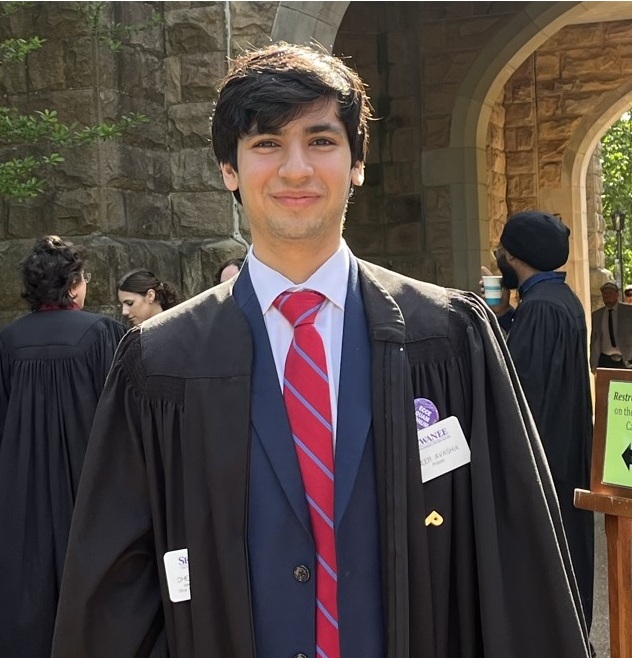
Hello, I'm Dheer Avashia
I am currently a PhD student in Economics at the University of Arizona, applying Behavioral-Industrial Organizational perspectives and methods to study how AI shapes consumer behavior and markets.
When I am not fighting with myself over identification, I am probably trying out a new musical instrument or optimizing (some would say unnecessarily) the brewing process of my next cup of coffee.
Research
Free Information, Costly Search: AI Summaries, Consideration, And Verification
Expand
Free Information, Costly Search: AI Summaries, Consideration, And Verification
This paper develops a demand-side model of search in which entering an option (product) reveals a free AI-generated compression of binary signals (reviews) and deeper individual inspection of those signals is costly. I embed a compression-based information structure into a dynamic search environment with both across-option consideration and within-option verification. I show analytically, for general signal-set sizes, that better underlying reviews lead to less review-reading when AI summaries are present: the verification threshold diverges as raw-signal precision approaches complete certainty, and the set of states in which costly inspection is optimal shrinks near perfect precision. The mechanism is that AI summaries compress the same evidence consumers would unpack at a cost, so improving raw-signal precision simultaneously strengthens the summary and devalues the underlying signals. By numerically solving the model with and without AI, I find that the costly search freed by AI-driven verification substitution can expand consideration sets, creating a reallocation from search depth to search breadth whose net effect on choice-quality outcomes is parameterdependent.
The Impact of AI-generated Review Summaries: Evidence From Indian E-Commerce
Expand
The Impact of AI-generated Review Summaries: Evidence From Indian E-Commerce
The rise of AI-generated overviews is transforming how consumers interact with information in digital markets. These overviews, powered by the development of large language models (LLMs), condense vast volumes of information into accessible narratives, potentially mitigating the effects of information overload and providing better insights into product characteristics. In this research, I focus on AI overviews of product reviews on e-commerce platforms and investigate whether they influence consumer purchasing decisions by affecting product-level sales and pricing. Leveraging variation in the adoption of these overviews across the two largest e-commerce platforms in India — Amazon and Flipkart — I apply a difference-in-differences framework, with three-way fixed effects, to isolate the effect of AI summaries. I aim to provide new, and among one of the first, to my knowledge, evidence on the role of algorithmic information processing and presentation of consumer reviews in shaping consumer behavior, market outcomes, and platform competition in digital markets.
Modeling Financial Volatility with Multinomial Generalized Auto-Regressive Conditional
Heteroskedasticity
Expand
Modeling Financial Volatility with Multinomial Generalized Auto-Regressive Conditional Heteroskedasticity
Modeling the levels of volatility for a portfolio of assets has been imperative in analyzing individual financial decisions. In this paper, I explore models that allow for volatility clustering (ARCH and GARCH) and specifically look at a five-year dataset of the S&P 500 stocks to model the returns to a portfolio of assets using Multinomial GARCH (DCCM).
Financial Overconfidence and Shocks
Expand
Financial Overconfidence and Shocks
Empirical evidence for the availability heuristic causing an erroneous meta-cognitive judgment of one's objective financial knowledge. The reasons for disparities in financial knowledge are often explored through the lens of policy action and education. However, in this research, we study the role of cognitive bias in financial knowledge to explain disparities in perceived and actual financial knowledge. We propose a model of overconfidence and then attempt to estimate how variance in levels of overconfidence can be explained specifically through the lens of exposures to financial shocks. Our analysis finds gender and educational differences in levels of financial overconfidence and finds empirical evidence that higher exposure to negative financial shocks predicts lower levels of overconfidence.
The Theory of Huffman Encoding
Expand
The Theory of Huffman Encoding
- In this project, I surveyed research in Algorithmic Information Theory. I understood the functions and mechanisms of Turing Machines, fundamental information theory concepts: Probability, Entropy, and Complexity. I then, specifically, focused on Huffman's Encoding Problem, analyzed proofs of optimal lossless encoding, theories of fundamental binary data encoding, and studied Huffman trees.
Bubble Formation in Experimental Spot Asset Markets
Expand
Bubble Formation in Experimental Spot Asset Markets
- Surveyed experimental economics literature on price bubbles and crashes in spot asset markets.
Social Media and Orthrexia Nervosa Onset In College Students
Expand
Social Media and Orthrexia Nervosa Onset In College Students
- Eating disorders are becoming highly prevalent in college students, as several studies have reported a greater presence of eating disorders on college campuses as compared to the general population (Fitzsimmons-Craft et al., 2019). Image expectations might help better understand the reasons for the onset of ON in college students. One such factor is Imaginary Audience. Imaginary Audience is a state in which individuals believe they are actively being judged by peers (Elkind & Bowen, 1979); it is one of the most frequent ideation states faced by adolescents (O'Connor, 1995). In this study, social media use is expected to predict levels of ON in college students, with Imaginary Audience as a potential mediating variable. Current literature search reveals sparse research on the connection between these two variables. This study uses an online survey to gather data about three constructs: the presence of an imaginary audience, social media use, and the prevalence of ON. The study predicts that a higher influence of social media and the prevalence of an imaginary audience will be positively associated with higher levels of ON in college students.
Work Experience
Teaching Assistant
Expand
Teaching Assistant
- Economics 200: Introductory Economics (Fall 2023)
- Economics 330: Macroeconomics and Global Institutions Policy — TA (Spring 2024)
- Economics 337: Economics of Politics and Policymaking (Spring 2024)
- Economics 407: Economics of Strategy (Fall 2024)
- Economics 443: International Trade (Fall 2024)
- PSY 230: Psychological Measurement and Statistics (Spring 2025)
- Economics 443: International Trade (Fall 2025)
- Economics 330: Macroeconomics and Global Institutions Policy (Fall 2025)
- Economics 550 Economics for Managers — MBA (Fall 2025)
User Experience & Marketing
Expand
User Experience & Marketing
- Researched business models and digital strategies of firms catering to the Indian rural market.
- Conceptualized and implemented, alongside the CEO, the marketing strategy for promoting the company's new mobile application, reaching over 2000 potential clients.
- Created KPI metrics, alongside CEO and UX designers, for a pilot study helping measure user accessibility and retention for the company's new mobile application, which now has over 5000 users.
- Researched and presented a comprehensive report on rural marketing. Worked with digital marketing head to run ad campaigns (Google Ads, IVR, on-ground marketing) increasing users by 20%.
Business Strategy & Content Production
Expand
Business Strategy & Content Production
- Analyzed business-to-business models and growth strategy of 10 major companies in the online learning industry. Generated user profiles and identified key trends in the executive learning industry and presented insights to CEO.
- Built several user profiles and led presentations on ideas for optimizing the company's product.
- Authored, edited, and published over 5 articles for on and off-page blogging.
- Ran ads and performed SEO optimizing, alongside the Digital marketing team, boosting social media followers by 30%.
VP Recruitment & Greek Life Assistant
Expand
VP Recruitment & Greek Life Assistant
- Assisted the director of Greek Life in everyday tasks.
- Created forms and surveys to gather data about Greek life organizations on campus; used Excel to format and present data to the head of Greek Life.
- Planned a hazing prevention marketing campaign to create awareness about hazing and provide resources.
- Made the Greek Life culture on campus safer and more welcoming.
Residential Assistant
Expand
Residential Assistant
- Designed and implemented over 15 programs to foster relationships and make residents feel safe and comfortable in residential spaces.
- Applied QPR training and restorative techniques to help extinguish sensitive situations and resolve conflicts.
- Acted as a student leader and role model for over 200 residents, cultivating living spaces with a strong sense of community.
- One of the most esteemed leadership positions on campus.
- Supervised residence halls with 150+ students, responded to emergencies, and reported to area manager.
Marketing Intern
Expand
Marketing Intern
- Researched student taboos surrounding mental health, evaluated data to devise a social media marketing plan and content calendar; increased student interaction and awareness by over 30%.
- Collaborated with the director of the Wellness Center and student leaders on campus to plan and implement 11 events promoting mental health awareness.
Lead Barista
Expand
Lead Barista
- Ensured smooth operation during shifts by optimally allocating tasks
- Produced high-quality (at least I thought so) lattes and sandwiches
Coursework
Graduate Coursework
Expand
Graduate Coursework
Quantitative / Applied
- Applied Economic Analysis
- Experimental Economics
- Industrial-Organizational Economics
- Labor Economics
- Computational Methods — Dynamic Models
- Applied NLP
Theory
- Econometrics
- High Dimensional Econometrics
- Advanced Game Theory
- Microeconomic Theory
- Mechanism Design
- Behavioral Economics
BSc Coursework
Expand
BSc Coursework
Mathematics
- Linear Algebra
- Multidimensional Calculus
- Differential Equations
- Abstract Algebra 1
- Abstract Algebra 2
- Real Analysis
- Probability & Statistics
- Time Series
Economics
- Microeconomic Theory
- Labor Economics
- Industrial Organizational Economics
- Game Theory
- Econometrics
- Seminar (Pass with distinction)
Psychology
- Research Methods and Data Analysis
- Child Development
- Cognitive Psychology
- Action Research Lab
- Personality Psychology